

- Home
- Shareholder Engagement of Corporate Japan [Second Edition]
Shareholder Engagement of Corporate Japan [Second Edition]
Creating Corporate Value Through Engagement and IR/SR Strategies in an Era of Intense Competition
This book provides essential insights, practical guidance, and key considerations for implementing IR strategies that strengthen shareholder relationships and support stock performance, alongside SR strategies to build long-term trust. It marks the first major revision in 12 years.
(IR: Investor Relations / SR: Shareholder Relations)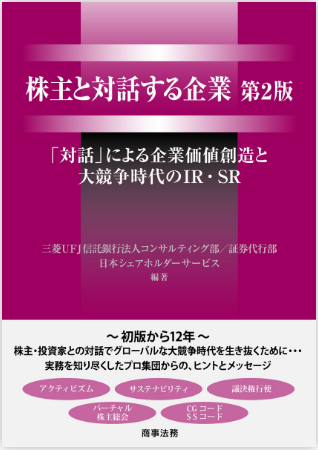
Table of Contents
- Part 1: Introduction
- Chapter 1: Introductory Statement
- Chapter 2: What the Two Codes Have Brought
- Part 2: Engagement with Institutional Investors
- Chapter 1: What Are Institutional Investors?
- Chapter 2: IR and SR Based on Investment Strategies
- Chapter 3: Institutional Investors' Exercise of Voting Rights and Engagement
- Chapter 4: From the Front Lines of Engagement
- Chapter 5: Proxy Voting Advisory Firms
- Chapter 6: Corporate Value and Finance Theory
- Part 3: Shareholder Activism and Corporate Control
- Chapter 1: Understanding Hedge Funds and Activism
- Chapter 2: Fund Activism and Responses to it in Japan
- Chapter 3: Preparing for Contingencies
- Chapter 4: Establishing a Market for Corporate Control
- Part 4: Corporate Governance and Sustainability
- Chapter 1: Corporate Governance Reform and Japanese Companies
- Chapter 2: Responsible Investment and ESG
- Chapter 3: Sustainability Communication
- Part 5: Engagement with Retail Shareholders
- Chapter 1: Investment Trends and Orientations among Retail Investors
- Chapter 2: The Significance of Shareholdings by Retail Investors
- Chapter 3: Information Disclosure to and Engagement with Retail Shareholders/Investors
- Part 6: Practical Considerations for Convocation Notices in the Engagement Era
- Engagement with Shareholders Through Shareholders' Meeting Convocation Notices
- Part 7: Engagement-Oriented Shareholders' Meetings
- Engagement at Shareholders' Meetings
- Part 8: Conclusion
- Summary
Part 1: Introduction, Chapter 1: Introductory Statement
Tatsuya Imade
Japan Shareholder Services
This book is a sequel to Shareholder Engagement of Corporate Japan (Shojihomu), published in early 2013 (hereinafter, “the previous work”).
The previous work carried the slogan: “Transforming companies that avoid engagement into those that earn trust through it.” Since then, almost all Japanese listed companies have entered an “era of engagement” with shareholders/investors. During this period, the average stock price of Japanese companies has increased more than fourfold in roughly 12 years. This book aims to help Japanese listed companies enhance their value by leveraging engagement with capital markets and shareholders/investors. To what extent has Japan been able to gain trust in its companies and its domestic market?
The themes addressed in this book are even more multifaceted and diverse than in the previous work.
Following a pandemic that lasted over two years, a rare event in modern history, the world appears increasingly fragmented, with wars erupting in multiple regions and climate change moving in an unfavorable direction. In the United States, president who espouses “America First” has returned to power, and the era of big data and artificial intelligence (AI) has become a reality. All of these factors are deeply intertwined with industry and capital markets.
In Japan, efforts to break away from the so-called “lost 20 to 30 years” following the collapse of the bubble economy have led to the launch of corporate governance reforms by the government under the “Abenomics” strategy for Japan's revitalization. This agenda, which includes reforms of the investment chain, continues today amid the global mainstreaming of responsible investment that takes ESG into account. These reforms appear to be intended to bring about the creative destruction of the post-war Japanese corporate model, which had effectively come to an end during the “lost” period.
For a comprehensive discussion, please refer to the full text.
This document is the intellectual property of our company and is protected by copyright law. Reproduction, distribution, or use of any part of this document without prior written permission from our company is strictly prohibited.